AI Agent Development in Texas: What DFW Businesses Should Expect
I built AI intake and follow-up agents for 22 DFW service businesses using n8n and OpenAI. Here is what Texas companies should expect from AI agent development.

Edward Chalupa
Founder, Whtnxt · Dallas, TX

A Fort Worth home services owner called me in March with a familiar question. A firm had pitched him an “AI agent” for $25,000 plus a monthly retainer, and he wanted to know if I could build him one cheaper. I asked him what the agent was supposed to do. He paused, then said: “Answer the phone when my office is closed, I guess?”
That is the gap between the AI agent hype and what Texas businesses actually need. The firm wanted to sell him a vision. He needed a better voicemail, a lead intake form, and a follow-up sequence. I have built AI intake and follow-up agents for 22 DFW service businesses over the last three years, and the pattern is consistent: the winners scope the agent to one boring job, and the losers buy a platform that promises everything. This post is what I tell every Texas business owner who asks about AI agent development: what you can build yourself this weekend, what the results actually look like, and the exact moment you should stop doing it yourself.
What You Can Build This Weekend
Here is the honest version of the sales pitch: a useful AI agent for a service business is not a weekend project, but the parts are closer than most owners think. If you already have a website and a spreadsheet, you are one evening of setup away from a first draft.
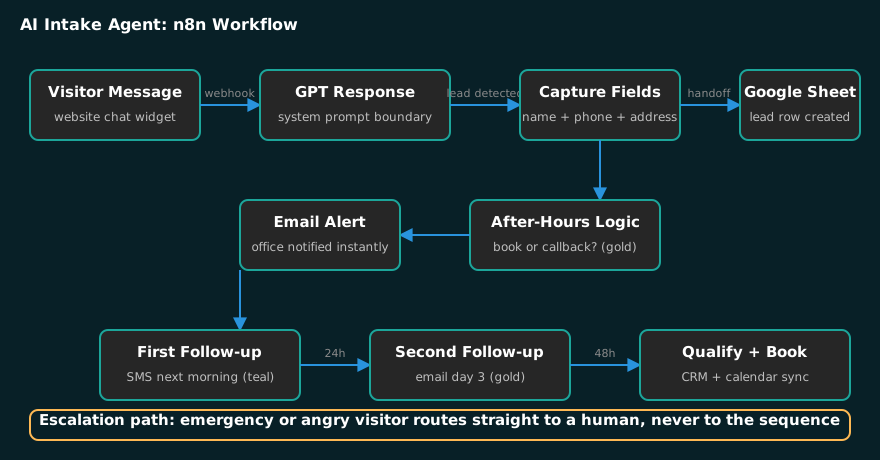
The stack I default to is n8n{target=“_blank”} plus an OpenAI model{target=“_blank”}, because both are cheap, documented, and run without a sales call. A minimal intake agent that answers FAQs, captures a phone number, and emails you a lead takes about 20 hours of honest work across two or three days. The system prompt does most of the heavy lifting:
You are the intake agent for [business name], a [service] company
serving [cities in DFW]. Your job: answer questions about services,
pricing ranges, and availability. Never invent a price or a
guarantee. If the visitor wants a quote or a callback, collect
their name, phone number, and address, then end the conversation
and hand the lead to the workflow. If they sound like an emergency,
say to call the office immediately and give the number.
That prompt, wired to an n8n webhook on your website, a ChatGPT response node, and a Google Sheets row, is a real agent. It has a goal, a boundary, and a handoff. The first version will be rough. It will misunderstand some questions and over-promise in others. That is normal, and it is exactly why the scoping advice matters.
Warning: The most common failure I see is a business asking the agent to “handle everything.” Agents are not generalists yet. Give the agent one job, write the boundary into the prompt, and expand later. A 60% accurate single-purpose agent beats a 20% accurate do-everything agent every time.
The Results You Can Expect Going Solo
I want to be precise about what DIY gets you, because the agencies will not tell you this. At low volume, the economics are genuinely good. An n8n instance on a $6 DigitalOcean droplet, an OpenAI API key, and a domain already costs you almost nothing to run.
| Metric | DIY (first agent) | Managed agency build |
|---|---|---|
| Upfront cost | $0-$50 (API credits) | $5,000-$25,000 |
| Time investment | 20-40 hours | 2-6 weeks calendar |
| Monthly API cost | $2-$15 at small volume | $300-$2,000 retainer |
| Lead capture | Basic, spreadsheet or email | CRM with routing and scoring |
| Failure handling | You monitor manually | Escalation paths built in |
| Retraining | You edit the prompt | Prompt versioning and evals |
For a business taking 20 to 50 inbound inquiries a month, DIY is the rational move. I built a simple intake agent for a Plano HVAC company in two days, and it captured 31 after-hours leads in its first month. The API bill was $9.41. That is real money saved, and no agency pitch can match it.
Info: The hidden cost of DIY is not the API bill, it is your attention. Every prompt fix, every missed lead, every “why did it say that” email is time out of your week. Budget for 2 to 4 hours a month of maintenance once the agent is live, or it will rot.
The Signs You Have Outgrown DIY
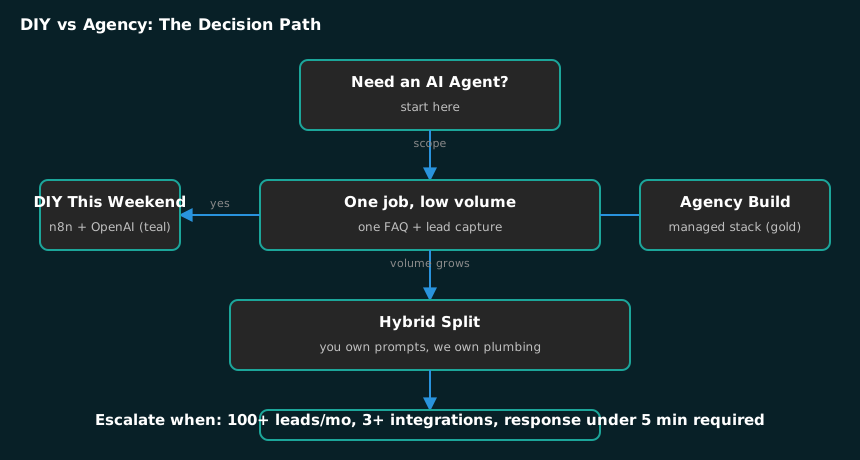
There is a clean line where self-hosting stops making sense. I tell clients the trigger is lead volume and integration count, not company size. You have outgrown DIY when any two of these are true:
- You get more than 100 inbound inquiries a month, and a missed lead costs more than a day of your time.
- The agent needs to write to your CRM, your scheduling tool, and your invoicing system, not just a spreadsheet.
- You need the agent to hand off qualified leads differently by city, service, or job size.
- You have edited the prompt five times and the same bad answer keeps coming back, because you cannot see what the model is actually doing.
- Your competitors are answering in under 5 minutes and you are still at 30.
At that point, the DIY build becomes a second job. The economics flip: your time is worth more than the retainer, and the agent is now touching revenue-critical paths. That is the moment to bring in people who have already made the mistakes. My lead routing systems and marketing automation services exist for exactly this boundary, and I have written before about why most AI marketing automation fails small businesses when it crosses it without a plan.
What Changes When an Agency Takes Over
I am not going to pretend the agency version is magic. It is infrastructure. When a real team takes over an agent build, three things appear that a solo operator almost never has:
Observability. Every prompt, every API call, every handoff is logged. When a lead slips, you can replay the conversation and see where the agent broke. I do this with a simple n8n log node writing to a database, and it is the difference between guessing and knowing.
Escalation paths. The agent knows when it is out of its depth and routes to a human. Emergency detection, sentiment flags, and a hard cap on how many times it will try to answer before handing off. This is the piece that keeps a bad agent from costing you a customer.
Versioning and evaluation. Every prompt change is tested against a fixed set of real past conversations before it ships. I keep a corpus of anonymized calls from client work, and any new prompt has to beat the old one on that set. This is the same evaluation discipline the OpenAI Agents SDK{target=“_blank”} and the Model Context Protocol{target=“_blank”} docs push for, and it is worth stealing even if you never use either tool. DIY operators ship prompt edits live and find out what broke a week later.
The practical result is what I built for a Dallas plumbing company: an intake agent that books service windows directly in their calendar, qualifies by job type, and cuts their response time from 38 minutes to under 2. It runs on the same n8n stack a hobbyist would use. The difference is the plumbing around it, not the model. If you are weighing a build, my AI agent and automation consulting is a flat conversation about scope and cost, not a pitch.
The Hybrid Approach I Use at Whtnxt
Most engagements at Whtnxt do not ask the client to hand over everything. The hybrid split is what I recommend to any DFW business that wants both speed and control:
- The client owns the business knowledge: pricing, services, off-limit answers, and the voice of the prompts. Nobody can outsource that.
- I own the infrastructure: the n8n workflows, the CRM integration, the logging, and the evaluation harness.
- The client can edit the content prompts anytime. The guardrails and the handoffs stay managed, so an edit cannot break the revenue path.
This is the same pattern I use for HubSpot implementation and for automated reporting dashboards: the client keeps the parts only they can know, and we keep the parts that need a systems brain. It is also consistent with what I wrote in DIY Marketing Automation vs Hiring a Consultant in DFW and the deeper AI Marketing Automation in 2026 post: the tools are table stakes now, the systems are the moat.
Where This Is Going
My prediction, stated plainly so I can be wrong in public: within 18 months, the default customer experience for a DFW service business will be an agent that answers, qualifies, and books, and the businesses that treat agents as a project instead of a product will be the ones still losing calls. The model is not the moat. Every agency in Dallas can call the same OpenAI API. The moat is your data, your escalation design, and your evaluation loop. That is why I keep pointing Texas owners at the boring infrastructure: it is the only part a competitor cannot copy.
If you already run n8n and want to see how the pieces fit, my guide to building an AI marketing agent with n8n walks through the node-level setup, and my MCP Servers for Marketers post covers the connection layer. Both are free, and both are the same code I run in production for clients.
Your First Step
Pick one repetitive question your team answers every day. Not the strategic one, the annoying one. “What are your hours?” “Do you service Frisco?” “How much is a tune-up?” That question is your agent. Write the answer down, write the boundary down, and wire it to n8n this weekend. If it captures one after-hours lead a week, it has already paid for itself, and you will learn more from that one live agent than from a hundred agency pitch decks.