B2B Marketing Automation in Texas: What Actually Works
I built B2B marketing automation with n8n for 22 DFW businesses and cut lead response from hours to 90 seconds. Here is the exact architecture that works.

Edward Chalupa
Founder, Whtnxt · Dallas, TX

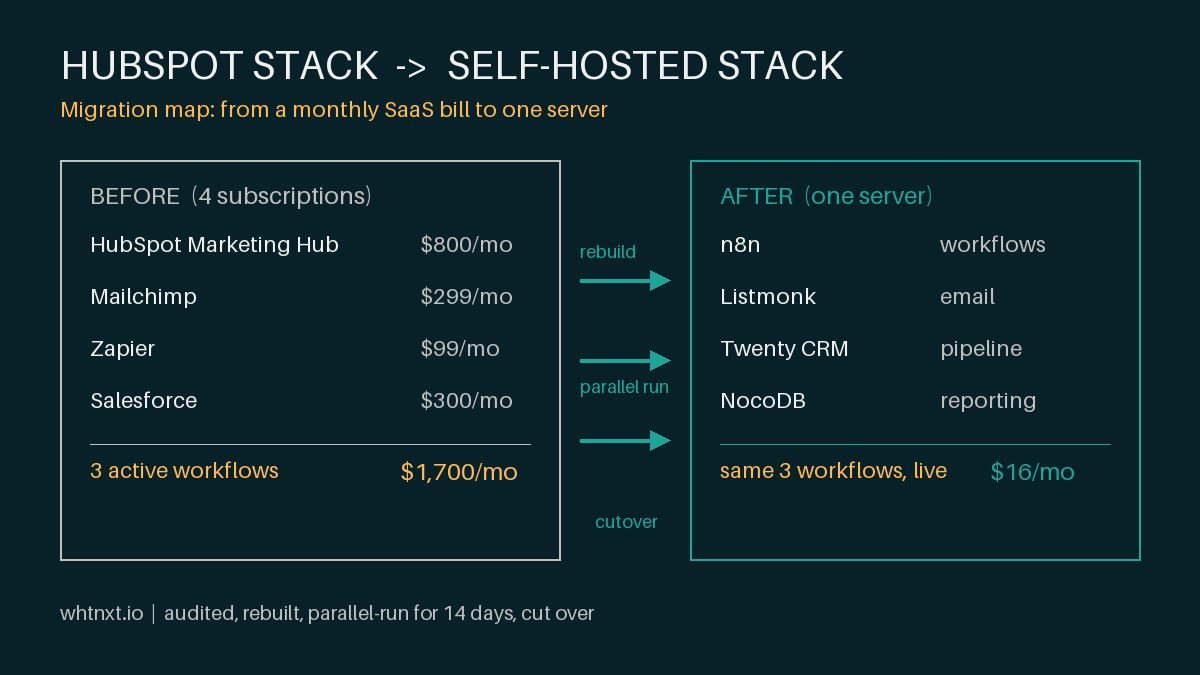
Most B2B marketing automation in Texas is a graveyard of expensive platforms and abandoned workflows. I know because I have walked into the aftermath. A Plano manufacturer paying $2,400 a month for a marketing cloud with three active workflows. A Dallas software firm with a full marketing automation suite and nobody who knows how to publish a campaign. The tools were not the problem. The way they were bought was.
I have spent the last three years building automation systems for 22 DFW businesses, and the B2B work follows a pattern that almost nobody talks about. The agencies and directories that rank for “b2b marketing automation services in texas” sell software subscriptions. I sell pipelines that move a lead from first touch to booked demo without a human touching a keyboard. This post is about the difference, and about the exact architecture I deploy for B2B clients in Texas.
Warning: If a B2B marketing automation pitch starts with a platform name and not a pipeline diagram, it is a software sale, not an automation project. The platform is the last decision, not the first.
The Context
B2B marketing automation in Texas is booming for the wrong reasons. The state added more than 1.4 million residents between 2020 and 2024, and Dallas-Fort Worth, Houston, and Austin are pulling in B2B companies faster than the local marketing talent can keep up. That gap produces a specific failure: companies buy enterprise automation tools before they have the operational foundation to use them.
Here is the pattern I see in almost every B2B account I audit. The company signs up for HubSpot Marketing Hub{target=“_blank”} or Marketo or Pardot, connects a few forms, imports the contact list, and then stops. The workflows that shipped in month one decay by month three because nothing routes the leads, nothing scores them, and nobody owns the system. The subscription renews every year. The automation does not.
I have audited 11 B2B marketing setups in Texas this year alone. Seven of them had fewer than four active automated workflows despite paying for full platforms. One had zero. That is not a tooling problem. That is a buying problem, and it is the entire context for how I build B2B automation differently.
What Most People Get Wrong
The biggest misconception in B2B marketing automation is that it is a platform problem. It is not. It is a pipeline problem.
Most agencies and directories position B2B automation as “pick a platform, connect your CRM, done.” That framing serves the software vendors, not the companies paying for it. Here is what it misses:
| Common Assumption | What I Actually See in Texas B2B Accounts |
|---|---|
| ”A platform is the automation” | A platform is a container. The workflows inside it are the automation, and most accounts have fewer than 4 active ones |
| ”Connect the CRM and leads flow” | Leads only flow if routing, scoring, and handoff rules exist first |
| ”More tools means more automation” | Tool sprawl is the #1 reason workflows die by month three |
| ”AI will fill in the gaps” | AI amplifies whatever pipeline exists. Broken pipeline, amplified noise |
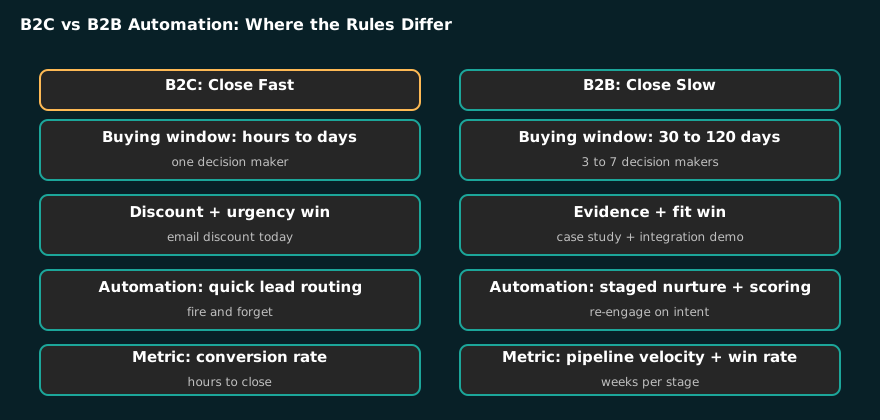
The second misconception is that B2B automation should mirror B2C automation. It should not, and this is where most implementations go wrong before a single workflow is built. B2C buyers decide in hours or days with one decision maker. B2B deals run 30 to 120 days with three to seven people involved. Automating a B2B pipeline like a B2C pipeline means routing leads to a salesperson once and calling it done, which is exactly what I see in most underperforming accounts.
The third misconception: automation replaces sales. It does not. It makes sales faster and more consistent. The best B2B automation I have built does not remove the salesperson. It removes the busywork around the salesperson: lead capture, qualification, scheduling, follow-up, and data entry. The salesperson still closes.
How It Actually Works
Here is the architecture I deploy for B2B clients in Texas. It is not platform-specific, and that is the point. I build it in n8n{target=“_blank”} because it is self-hosted, cheap, and flexible, but the logic transfers to any platform that can run workflows.
The pipeline has six stages, and every one of them has a rule:
- Capture. Every lead source writes to one place: web forms, Google Ads, LinkedIn, referrals, tradeshow scans. No lead lives in a silo.
- Score. Every lead gets scored on three dimensions: intent, budget fit, and timeline. I documented the exact scoring criteria in my lead scoring model post.
- Route. Scored leads route by rule: hot leads hit a salesperson’s phone within minutes, warm leads enter a nurture sequence, cold leads wait for re-engagement.
- Follow up. The system sends the first touch, schedules the second, and escalates if there is no reply.
- Nurture. Not-ready leads get staged case studies, comparison content, and integration walkthroughs over 30 to 90 days.
- Revive. Leads that went quiet get re-scored when new intent signals appear, like a return visit or a downloaded asset.
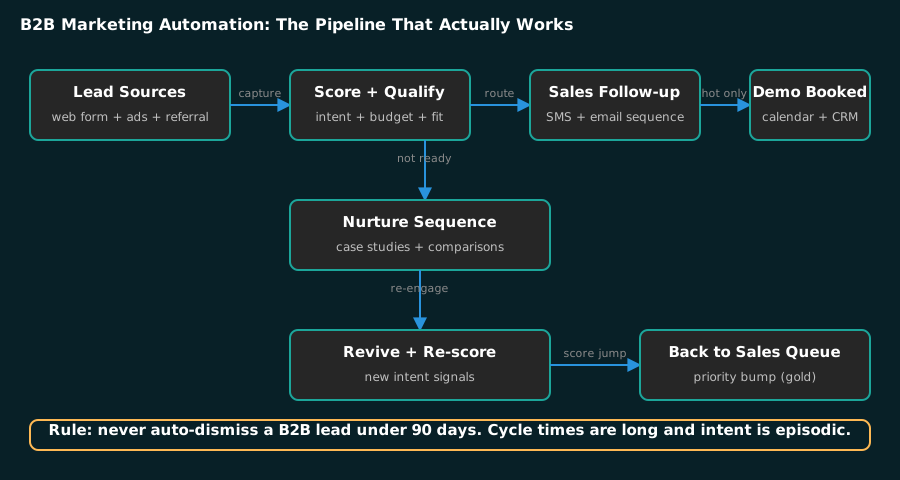
The rule that separates this from a generic setup: never auto-dismiss a B2B lead under 90 days. B2B buying cycles are long and intent is episodic. A lead that scores low in week two can become a hot opportunity in week six because the budget cycle closed. The system has to keep the lead alive, re-score it, and surface it again. Most platforms default to “score once, route once, forget.” That default is why B2B automation underperforms.
Here is a concrete workflow skeleton from the systems I deploy:
{
  "workflow": "B2B Lead Pipeline",
  "trigger": "Webhook (form, ads, LinkedIn, referral)",
  "stages": [
    "1. Normalize lead into single schema",
    "2. Score: intent (0-40) + budget fit (0-35) + timeline (0-25)",
    "3. Route: score >= 70 -> sales phone alert; 40-69 -> nurture; < 40 -> wait",
    "4. Follow up: SMS at 5 min, email at 30 min, call task at 2 hours",
    "5. Nurture: case study day 3, comparison day 10, demo invite day 21",
    "6. Re-score on every return visit or asset download"
  ]
}
That skeleton is the same across every B2B client I have. The thresholds shift, the content changes, but the shape does not. The shape is what makes it work.
The scoring runs on a lightweight model call that costs about one cent per hundred leads and takes roughly 400 milliseconds per lead. I wrote up the full classification setup in my AI marketing automation post, including the 60/30/10 split that determines where AI belongs in a marketing operation.
What This Means for B2B Marketers in Texas
If you run B2B marketing for a Texas company, here is what this architecture means for your day to day.
Your response time is your first differentiator. When I set up a B2B pipeline for a DFW client, the first thing we fix is lead response. The system routes a qualified lead to a salesperson’s phone in minutes, not hours. That single change moves more pipeline than any campaign tweak, because the first company to respond wins an outsized share of B2B conversations. I described the mechanics in my lead routing automation post.
Your nurture sequence is a sales asset, not an email drip. The B2B nurture sequences I build send case studies, integration walkthroughs, and pricing comparisons on a 30 to 90 day timeline, tied to intent signals. When the lead returns to the site or downloads a comparison sheet, the sequence re-routes them back to sales with a priority bump. This is the difference between a drip campaign and a pipeline.
Your reporting should show pipeline velocity, not email opens. B2C metrics like open rate and click rate are vanity in B2B. The numbers that matter are time-to-first-response, time-in-stage, and win rate. I build marketing reporting dashboards that pull these directly from the pipeline, so the marketing team and the sales team argue about the same numbers, and package them into marketing analytics services for clients that want the visibility without the build.
Info: The single highest-leverage automation I deploy for B2B clients is the handoff between marketing and sales. When a lead crosses the score threshold, the system creates the CRM record, schedules the first follow-up, and notifies the correct rep with context. I built a version of this in 90 seconds per deal using n8n, Twenty, and InvoiceNinja, documented in my deal-to-cash pipeline post. That handoff is where B2B automation pays for itself.
Your stack should not cost more than your pipeline is worth. I run B2B clients on n8n, Twenty CRM{target=“_blank”}, NocoDB, and Listmonk for a fraction of the enterprise platform cost. One North Texas client replaced 14 SaaS tools with this stack and cut monthly spend 38%. The full stack is in my open-source marketing stack post, and the strategic framework for choosing tools is in my DFW marketing automation framework.
Where This Is Going
Here are three predictions specific enough to be wrong.
Prediction one: the B2B marketing automation winner in Texas will be measured by pipeline velocity, not feature counts. Companies are starting to audit their automation the way they audit ad spend, asking what each workflow actually produces. The platforms that make pipeline logic visible will win. The ones that sell feature grids will lose.
Prediction two: self-hosted stacks will eat a meaningful share of the SMB B2B automation market in the next 24 months. The cost difference is too large to ignore. When a company can run n8n, Twenty, NocoDB, and Listmonk for under $100 a month in infrastructure versus $2,400 a month for a marketing cloud, the CFO eventually notices. I have already seen this shift in the North Texas market.
Prediction three: AI agents in B2B marketing will be bought as narrow tools, not platforms. The companies that deploy AI to score leads, draft follow-ups, and summarize accounts will see returns. The companies that buy a platform promising all of it will repeat the HubSpot mistake: expensive subscription, three active workflows, nobody in charge. I covered the agent development landscape in my AI agent post.
Your First Step
Stop evaluating platforms. Map your lead pipeline on paper first.
Here is the exercise I run with every B2B client before recommending anything:
- List every way a lead can enter your business (form, ads, LinkedIn, referral, tradeshow).
- Draw what happens after each entry point, hour by hour, for the first 48 hours.
- Count how many of those steps require a human to remember to do something.
Every “human remembers” step is an automation candidate. Most B2B companies find 15 to 30 of them in the first pass. That list is your roadmap. The platform comes after, and it is the cheapest part of the project.
I have seen this exact exercise turn a $2,400-a-month platform with three workflows into a $300-a-month stack with 40 active automations for the same company. The difference was never the tool. It was the pipeline design, and that is what my marketing automation services actually deliver. When the pipeline needs a dedicated lead generation system or marketing analytics on top, I build those too.
B2B marketing automation in Texas does not fail because the tools are bad. It fails because companies buy the tools before they design the pipeline. Design the pipeline first, route every lead, score every lead, never dismiss a lead under 90 days, and measure velocity instead of opens. Do that and the platform choice almost stops mattering. That is what actually works.
If you want to see whether your B2B pipeline is leaving revenue on the table, get in touch. I will map your first 48 hours with you.